Lead, don't perform
So you walk into the room like a man in his prime
Performing is for a camera. Leading is for her.
This is the last lesson. If you've done the exercises, you already have more tools than most men ever get. Today we put them together, and figure out where you are.
What you're getting today
- Where you are right now on the body and mind map
- The difference between performing and leading
- A 30-second posture shift to use before you walk into the room
- Your whole course in one list
Why it matters
Most men think the goal is to perform better. It isn't. Performing is about you: How am I doing? Is it working? That's exactly the loop from lesson 4.
Women don't want a performance. They want a man who's calm, present, and willing to take the lead.
How this helps you
When you stop performing and start leading, the pressure disappears, because the question in your head changes from "Am I doing this right?" to "Where are we going next?" One makes you tense. The other makes you present.
Part 1: where are you?
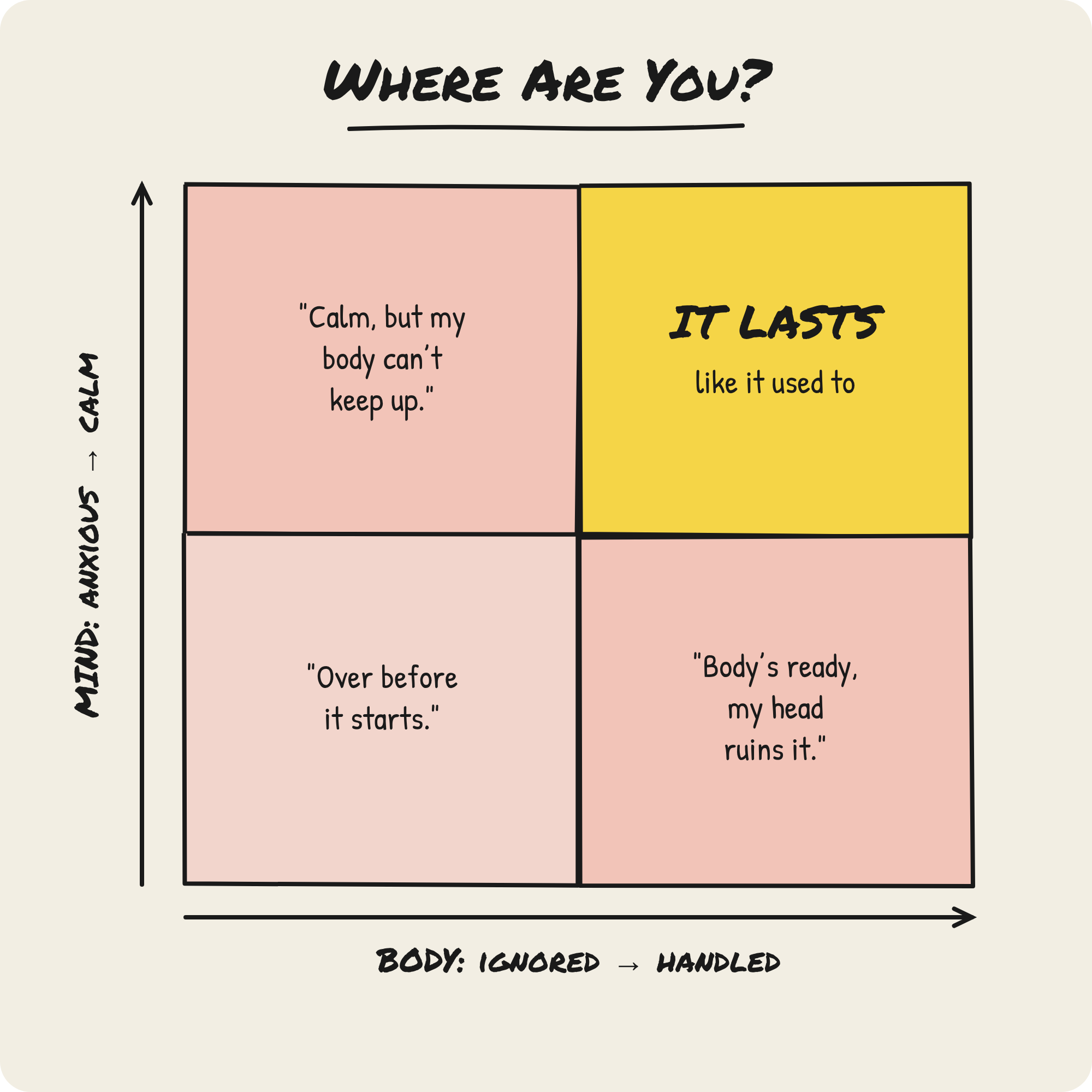
Look at the map at the top of this page. Two questions decide where you land: is your body handled, and is your mind calm?
- Body ignored, mind anxious: "Over before it starts." This is where I lived for most of my life.
- Body handled, mind anxious: "Body's ready, my head ruins it." This is where I was after fixing my hormones and losing the belly.
- Body ignored, mind calm: "Calm, but my body can't keep up." Mindset alone can't fix low hormones or poor blood flow.
- Both handled: it lasts, like it used to.
Most men over 40 live in one of the first three. Lessons 1 and 1.5 are your body. Lessons 2, 3, and 4 are your mind. You now have both halves.
Part 2: lead, don't perform
Leading doesn't mean being loud or aggressive. It means being calm enough to take initiative. Slowing down when you want to. Choosing the pace. Asking what she wants, then giving it with confidence.
Calm arousal makes that possible. Getting out of your head makes it natural. And the more you lead, the less room there is for the worry.
Part 3: the posture shift
Your body tells your mind how to feel, not just the other way around.
Stand up. Plant your feet. Open your chest, drop your shoulders, level your chin. Breathe in for 4 and out for 8, three times. Fire your calm button.
Notice how differently you feel? Calm and grounded is the posture of a man who leads. Do this before you walk into the room.
Your whole course in one list
- The four systems: body and mind both matter
- "It's just age" isn't an answer: find your cause, ask for free and bioavailable testosterone
- An erection is a relaxation response: build your calm button
- Calm arousal: relax more as it gets more intense, and notice your 7
- Get out of your head: widen your senses, make it about her
- Lead, don't perform: calm, present, and taking the lead
What Stirling sees in men that we can't see in ourselves
The more I talked with Stirling, the more I noticed something. He almost never talked about technique first. He talked about who you are when you walk into the room.
That's the final mindset shift, and maybe the biggest: you don't perform your way into confidence. You lead your way into it. Calm, present, choosing the pace. The techniques from this course are the tools. Leading is the man using them.
You stood up a minute ago. Planted your feet, opened your chest, breathed, pressed your calm button. That's the posture. Now imagine her seeing that man walk in: no hesitation, no checking, just quiet certainty.
You've finished the course. You have both halves now, body and mind. If you never buy anything, you can still use everything you've learned. But if you want to keep going with the man who taught me:
See where Stirling takes it next →Whatever you do next, thank you for doing this course. You already have the tools. Use them.
— Máni
Not medical advice. Erection problems can be a sign of heart or blood-vessel problems, so talk to your doctor. My results are my own; yours will vary.