Relearn how firm erections actually work
So you stop trying harder, and start relaxing deeper
One sentence changed everything for me. It came from a pornstar.
I know how that sounds. Stay with me.
Yesterday you wrote your doctor's list. That's the body side. Today is the side no doctor ever addressed for me, and the side that changed the most.
What you're getting today
- The one sentence that explains why trying harder makes it worse
- Why your body treats pressure like danger
- How to build a "calm button" you can press anytime, in 2 minutes
Why it matters
You've probably felt this. Everything's fine, and then the moment comes, and a voice in your head starts: "Is it working? Is it firm enough? Not again." And it fades.
That's not a broken body. That's a body doing exactly what it was built to do. You just never learned the rule it follows.
How this helps you
Once you know the rule, you stop fighting your own nervous system and start working with it. From here on, every time pressure shows up, you'll know exactly what to do about it.
Part 1: the sentence
Here it is:
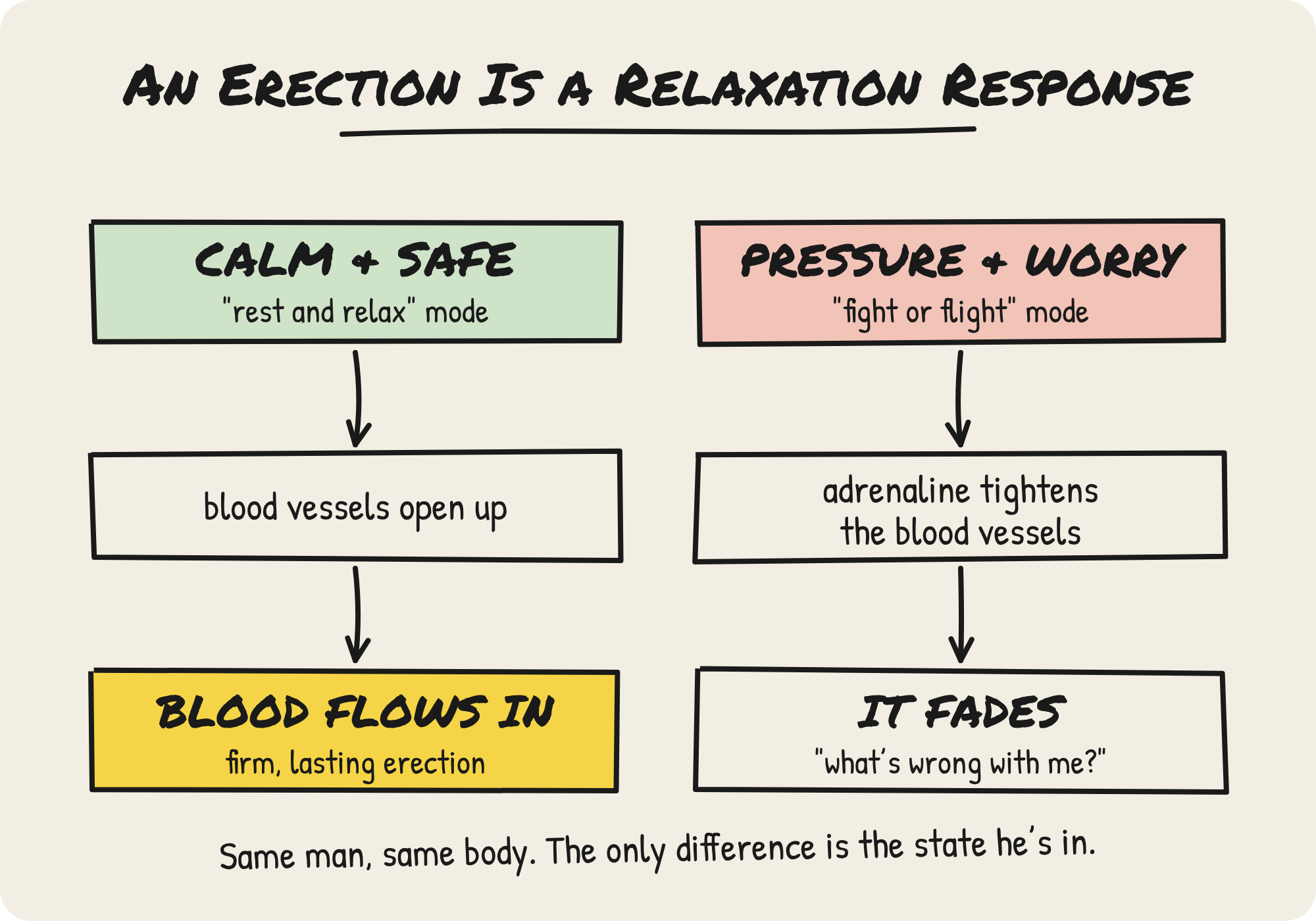
An erection is a relaxation response.
Look at the drawing at the top of this page. Same man, same body. On the left he's calm and feels safe, so his blood vessels open, blood flows in, and he's firm. On the right he feels pressure and worry, so his body releases adrenaline, adrenaline tightens the vessels, and it fades.
Your body can't tell "danger" from "pressure to perform." Both trigger fight-or-flight. And nobody needs an erection while running from a bear.
That's why trying harder makes it worse. You can't force a relaxation response. You can only allow it.
There's actually more to it — how an erection really works, the nerves, the blood flow, the whole sequence — and I'll be honest, I didn't even know most of it. I learnt that from a pornstar. (yeah, I know!) But like my ex always says 🙄 "it is what it is."
Part 2: who taught me
Stirling Cooper is a former award-winning adult-film performer who now coaches men on sexual health and performance.
Think about his old job for a second. Perform on cue. Under bright lights. With a whole film crew watching, a director waiting, and everyone's paycheck depending on it. No second takes for that.
If anyone on earth understands performance under pressure, it's him. As he told me, after that, the bedroom at home is a piece of cake.
I bought all his books. Then I emailed him with questions, and he wrote back. We've been going back and forth ever since. He's the master; I'm the student. When I told him what changed for me, he wrote back: "Great work, mate!"
Part 3: build your calm button
This is one of the simplest tools I know. Athletes use it to get into their best state on demand. In NLP it's called an "anchor": a link between a small physical touch and a feeling. You're going to build one for calm.
- Remember a time you felt completely relaxed and safe: a beach, a hammock, a warm bath, a Sunday morning.
- Step into it. See what you saw. Hear what you heard. Feel the warmth. Make the colors brighter and the feeling stronger.
- At the peak of the feeling, press your thumb and middle finger together firmly for a few seconds.
- Shake it off. Open your eyes and think about something neutral, like what you had for breakfast.
- Repeat 5 times. Then test it: press your thumb and finger together and notice the calm come back.
Practice it once a day this week. Every rep makes it stronger. You'll use it in the next two lessons, and in the moments that matter.
What a man who performed for a camera knows that your doctor doesn't
Here's what Stirling told me that stuck: after performing in front of a film crew, the bedroom at home is a piece of cake.
Read that again. The pressure was never really about the bedroom. It's about what's going on in your head.
Most men try to fix performance anxiety with more performance: a pill, a technique, trying harder. Stirling fixed it the other way around. He changed the meaning of the moment, and the body followed.
That's the mindset shift I didn't have for 30 years. And honestly, it matters more than any technique I've learned. Techniques work when you're calm. The mindset is what makes you calm.
You just built your calm button. Pressed it. Felt it come back. Now imagine having the full map: the 9 mental blocks that kill erections before they start, and how to take each one apart, so you're not just calming down in the moment but removing the reasons you tense up at all.
That's what's inside The Ultimate Guide to Performance Anxiety. It's 72 pages. You can read it in an evening.
Not for every man. If your problem is purely physical, start with your doctor's list. But if you recognized yourself in that voice saying "Is it working?", this is the book.
Next: tomorrow, how to relax more as things get more intense. It's the one that helped me most.
— Máni
Not medical advice. My results are my own; yours will vary.