Why your energy and drive aren't what they were at 30
Your free guide
Before anything else, download the ultimate guide to energy and drive: Why Your Energy and Drive Aren't What They Were at 30.
Download your guide →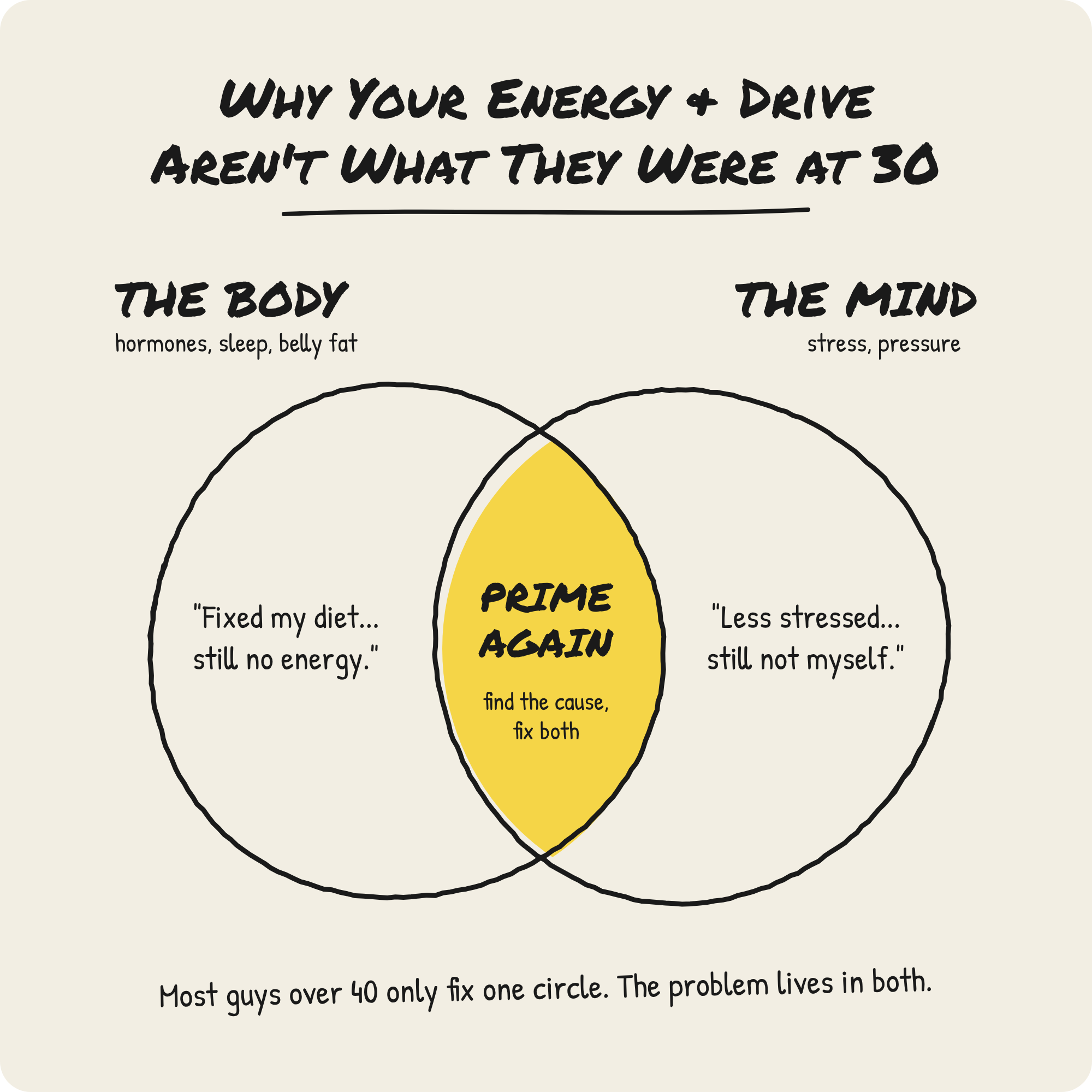
We have to talk about the fuel behind all of it: your hormones, your brain chemistry, and the daily habits that either build them up or quietly drain them. This is where boosting your energy and drive actually starts.
A lot of what I learned here came from my friend Stirling Cooper, a former performer whose body had to work every single day, on camera. When your job depends on it, you figure out what really moves the needle.
What you're getting today
- Why "your testosterone is fine" can be true and still leave you running on empty
- The 3 daily levers that help your body make testosterone: food, sleep, and lifting
- The protein that was stealing my testosterone, and what Stirling uses to fight it
- The dopamine reset: why porn and your phone can flatten your motivation and drive
- The real causes of low sex drive after 40, and what to do about each one
Why it matters
Low energy and low drive feel like "just getting older." But they're often signals. Your body is telling you something is off: a hormone, a habit, your sleep, or your brain's reward system. When you treat it as "normal," you stop looking. When you stop looking, nothing changes.
How this helps you
By the end of today you'll know which levers are in your hands right now, tonight, for free, and which ones need a conversation with your doctor. You'll also start the one habit that changed my drive more than any supplement I ever bought.
Part 1: "fine" isn't the same as full
For 15 years, doctors looked at one number, my total testosterone, and told me I was fine.
At 50, a doctor who specializes in hormones finally checked the rest. My total was 540. Looks great. But my free testosterone, the part my body could actually use, was near the bottom.
Here's why. A protein in your blood called SHBG (sex hormone binding globulin) grabs testosterone and holds onto it. Bound testosterone can't do its job. So you can have plenty in the tank and still not be able to use it.
Think of it like a paycheck. Total testosterone is what you earned. Free testosterone is what actually lands in your account after everything gets taken out. You live on what lands, not on what you earned.
Lesson 1.5 gives you the full doctor's list. Today is about what you can do yourself.
Part 2: the 3 levers you control
When I started looking for patterns in how my friend Stirling Cooper and other performers live, men whose careers depend on their hormones working every day, three things kept showing up.
Lever 1: eat the fats you were told to fear.
Your body makes testosterone from cholesterol. It's literally the raw material. For years we were told to avoid eggs, butter, and red meat. Stirling's book walks through the research linking more dietary cholesterol with higher testosterone.
His go-to sources: whole eggs (the yolk is the point), grass-fed butter and steak, lamb, and wild-caught fish. Pasture-raised eggs with deep golden yolks are the best you can buy.
One trick I took straight from him: eat your healthy fats at dinner. Testosterone production peaks overnight, typically before 8 a.m. Giving your body the building blocks in the evening means it has what it needs while you sleep.
(If you have high cholesterol, heart disease, or a family history, talk to your doctor before changing your diet. Your situation matters more than any general rule.)
Lever 2: protect your sleep.
Your body makes much of its testosterone while you sleep. Cut your sleep short and you cut your production short. That's why late nights, 3 a.m. wake-ups, and a phone in bed hit your energy and drive so hard the next day.
The basics work: a consistent bedtime, a dark, cool room, no screens for the last 30 minutes, and caffeine before noon.
Lever 3: lift something heavy.
Strength training doesn't just bump testosterone for an hour. Stirling cites research showing that over time, your body adapts to a new normal. In one study, men new to lifting saw a 40% rise in resting testosterone and a 24% drop in resting cortisol (the stress hormone) after just 4 weeks of strength training.
You don't need two hours a day. Two or three sessions a week of squats, presses, rows, and deadlifts, at a weight that's challenging but safe for your joints, is enough to start. (If you're new or have injuries, start lighter and get coached.)
Part 3: the protein stealing your testosterone
Back to SHBG, because this was my problem.
In his book, Stirling lists two things he uses to help keep testosterone free instead of bound:
- Vitamin D. Most of us don't get enough sun. Low vitamin D is strongly linked to low testosterone, and studies have tied more sunlight or vitamin D to higher free testosterone. Get your level tested (it's on your doctor's list in Lesson 1.5).
- Stinging nettle root. Stirling uses it because it may help stop SHBG from binding testosterone, so more stays free and usable.
His book gives the doses he uses. I'm not going to tell you to take anything. Bring these two names to your doctor, especially if your free testosterone or vitamin D comes back low. Supplements can interact with medications. I learned that the hard way: one combination made me lightheaded within an hour.
The cheapest SHBG lever? Losing belly fat. When I went from about 30% to 15–16% body fat, my energy, my drive, and my morning erections came back.
Part 4: the dopamine reset
This one surprised me most.
Dopamine is your brain's motivation chemical. It's what makes you want things: food, success, sex, a reason to get off the couch.
Here's the problem. Porn, endless scrolling, sugar, and alcohol flood your brain with dopamine, all day, with no effort. Your brain protects itself by switching off some of its dopamine receptors. Then normal life, including a real woman, feels flat. You need more and more stimulation just to feel normal.
The good news: those receptors can recover.
Stirling's fix is a 30-day dopamine fast. For 30 days, cut out:
- Porn and masturbation
- Sugar and alcohol
- Mindless social media
(Notice what's not on the list: sex with a partner.)
When I quit porn, it reset my brain's reward system. Real intimacy started to feel like something again, and my drive came back stronger than it had been in years. This single habit did more for my drive than anything I ever bought in a bottle.
Part 5: why your sex drive dropped
Low drive after 40 almost always has a cause, often more than one. Here are the usual suspects, and what to do about each:
| Cause | What to do |
|---|---|
| Low free testosterone | Get free and bioavailable tested, not just total (Lesson 1.5) |
| High prolactin, a hormone that switches desire off | Ask your doctor to test it; it's on your list |
| Sugar and high insulin, which drain drive and raise stress hormones | Cut sugar and refined carbs; get your A1c checked |
| Chronic stress (cortisol) | Daily calm practice (Lessons 1 and 2), lifting, sleep |
| Porn and constant stimulation | The 30-day dopamine reset |
| Belly fat | Lift, walk, eat whole foods; it lowers SHBG and estrogen |
| Alcohol | A drink is fine. Several a night dulls everything. |
| Medications | Some blood pressure drugs and antidepressants affect drive. Never stop one on your own; ask your doctor about options. |
You don't have to fix all of these. Find your two or three. That's where the change is.
Three things, starting today:
- Tonight's dinner: build it around a fat source from Lever 1 (eggs, steak, salmon, butter on your vegetables).
- Tonight's bedtime: pick a time 7–8 hours before your alarm, and put your phone outside the bedroom.
- Start your 30-day reset tomorrow: no porn, no sugar, no mindless scrolling. Write today's date + 30 on a sticky note and put it where you'll see it every morning.
Then add vitamin D and prolactin to your doctor's list (you'll get the full list in Lesson 1.5).
Next: tomorrow, Lesson 1: the four systems behind an erection, and the 60-second exercise that shifts your body into the state it needs.
If the fuel side just made something click, this is where I learned it
Almost everything in today's lesson (the cholesterol-and-testosterone link, eating fats at night, the lifting research, vitamin D and nettle root for SHBG, the dopamine fast, prolactin and low drive) I learned from one book by my pornstar friend, Stirling Cooper.
Its title makes people laugh: How I Grew My Penis. Ignore the title. It's the subtitle that hooked me: "…and Other Porn Industry Secrets."
It's the most complete playbook I've found for the body side of being a man: hormones, blood flow, brain chemistry, and the daily habits behind them. Written by someone whose job depended on all of it working, every day, on camera.
Here's what's inside
- The testosterone chapter: foods, timing, training, and the habits performers use
- The supplements and biohacks he uses, with the reasoning and research behind each
- The dopamine fast, step by step, and how to come back from it without the old habits
- Low drive and prolactin: why desire switches off, and natural ways he handles it
- Building a performer's body: leaner, fitter, stronger, more flexible
- The mind of a pornstar: the mindset side, and the tools to build it
- About 138 pages
Fair warning: his sales page doesn't hold back. Affiliate link: I earn a commission if you buy. I bought it myself first.
Not ready? That's completely fine. Tonight's dinner and bedtime are free, and they're a real start.
— Máni
Not medical advice. Talk to your doctor before changing your diet, starting supplements, or changing medications, especially if you have heart disease, high cholesterol, or take prescription drugs. My results are my own; yours will vary.